 Made in India

Brinell 250-TSPC
Touch Screen PC-based Brinell Hardness Tester, 250 kgf
Brinell 250-TSPC
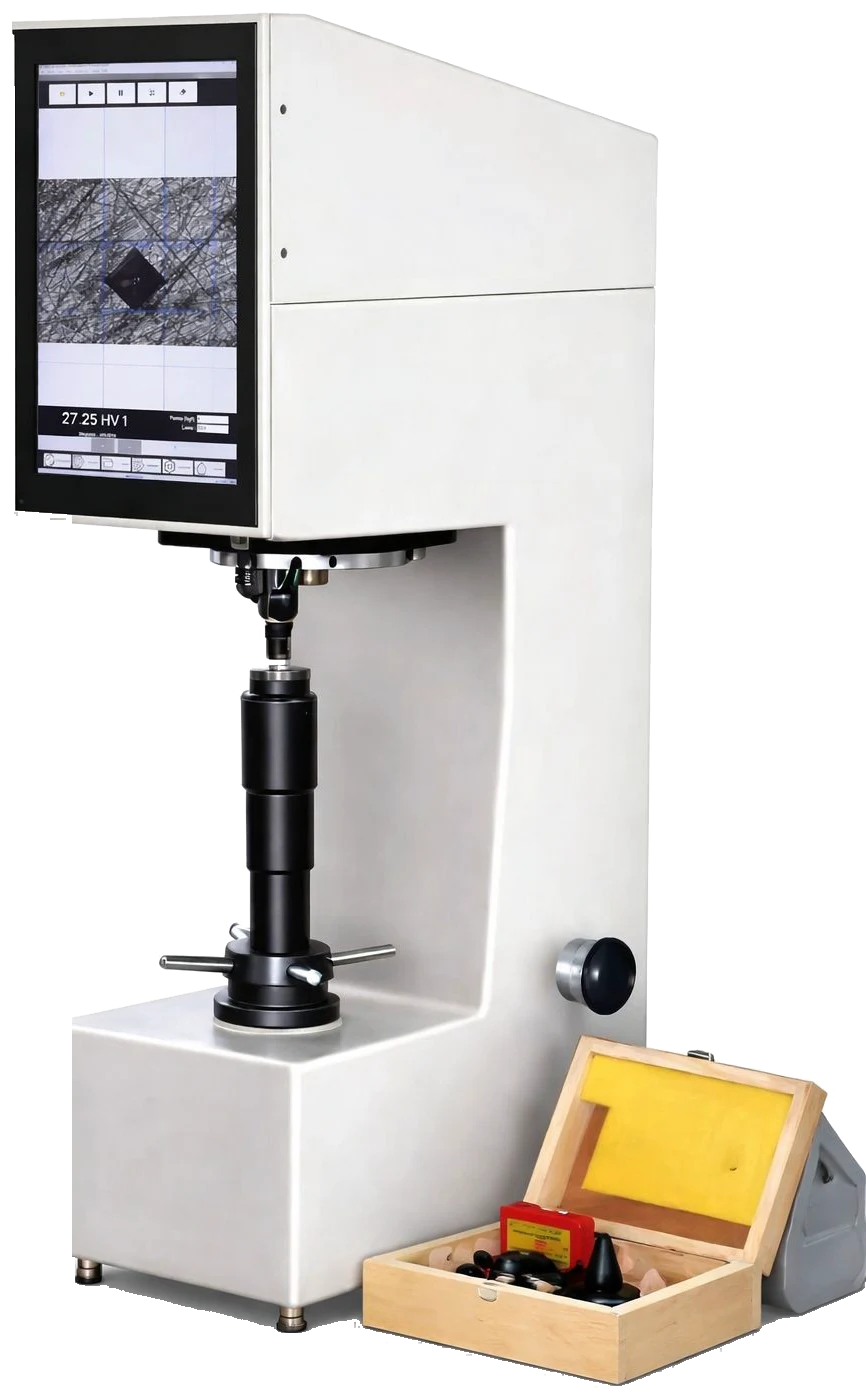
Compact industrial-grade touch-screen PC Brinell tester for soft metals up to medium-hard steels with 62.5, 187.5 and 250 kgf loads. The specimen is placed on the table and the whole cycle is automatic: a precise load is applied to the ball indenter through levers and weights, removed after the dwell, and the CCD camera image of the impression is digitised and measured by the PC to give the Brinell hardness number directly.
The Brinell 250-TSPC is a compact, industrial-grade Brinell hardness tester from Eklavya Techno Solutions, Ichalkaranji, India, built around a touch-screen PC and a CCD camera. It applies 62.5, 187.5 or 250 kgf through dead weights and levers with a motorised load, dwell and unload cycle, using the supplied 2.5 mm or 5 mm ball indenter. After the cycle the operator focuses the impression on the monitor and the software measures the diameter to 0.001 mm and displays the Brinell hardness number directly, then saves it to a batch file for reports and statistics.
The low loads are the point of this machine. HBW 2.5/187.5 gives steel-equivalent Brinell numbers with an impression small enough for finished components, and 62.5 kgf with a 2.5 or 5 mm ball suits aluminium, copper alloys and thin sheet, so the test is effectively non-destructive on many parts. At about 70 kg with a 585 x 290 x 860 mm footprint and a single-phase 220 V supply it fits a quality-control bench rather than a foundry floor, with 200 mm test height and 135 mm throat depth. The 250-TSPC complies with IS 1500 (Part 2) and ASTM E10 and is supplied with a test block, weights, flat and V anvils, the software dongle and pen drive.
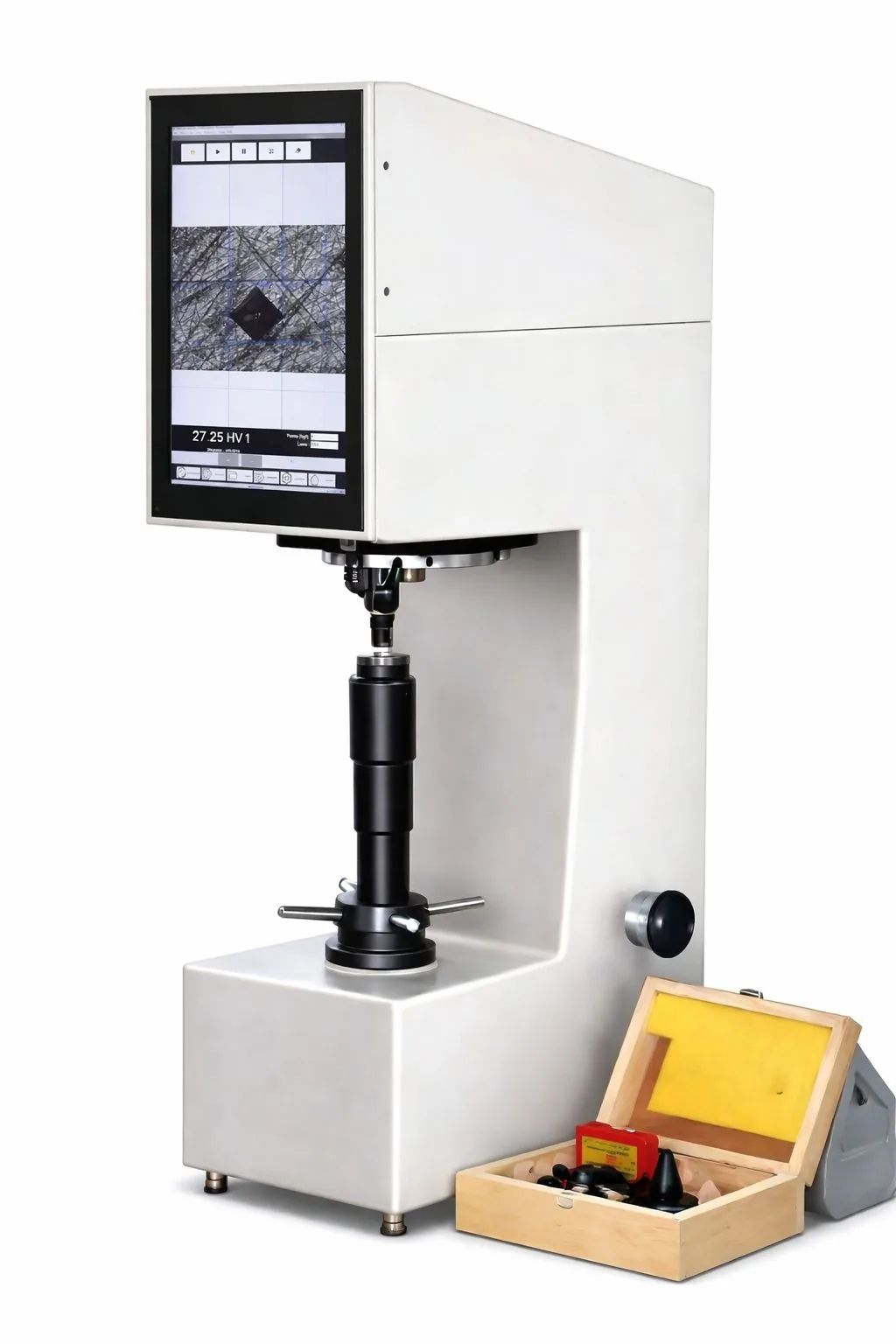
Test loads: 62.5, 187.5, 250 kgf
IS 1500 (Part 2) – Brinell hardness test – verification and calibration of testing machines
ASTM E10 – Standard test method for Brinell hardness of metallic materials
| Parameter | Brinell 250-TSPC |
|---|---|
| Type | Brinell, dead-weight loading, motorised cycle, camera measurement on touch-screen PC |
| Test loads | 62.5, 187.5, 250 kgf |
| Indenters supplied | 2.5 mm and 5 mm ball indenters |
| Max. test height | 200 mm |
| Depth of throat | 135 mm |
| Scale least count | 0.001 mm |
| Diagonal measuring range | 0.05 to 0.4 mm |
| Machine dimensions (L × W × H) | 585 × 290 × 860 mm |
| Net weight (approx.) | 70 kg |
| Power supply | 220 V AC, 50 Hz, 1 phase |
| Standard accessories | Standard test block, weights, flat anvil, small and big V anvils, spanners, electric cord, software licence dongle, Brinell software pen drive, instruction manual |
| Note | Printer not in standard scope of supply |
Three loads, 62.5, 187.5 and 250 kgf, applied through levers and dead weights with a motorised cycle, and 2.5 mm and 5 mm ball indenters supplied. HBW 2.5/187.5 is the usual steel and cast-iron scale, HBW 5/250 and 2.5/62.5 suit aluminium and copper alloys, and 62.5 kgf with the 5 mm ball is for the softest metals and thin sheet.
Yes. The CCD camera image of the impression is digitised on the touch-screen PC; the operator focuses it on the monitor and the software measures the diameter with a least count of 0.001 mm and calculates the Brinell number. Results go into batch files with standard deviation, mean, median and histogram, and the software has calibration and verification functions on screen.
Quality-control benches testing finished or semi-finished parts where a 3000 kgf impression would be too large: machined castings, forged blanks, heat-treated components in the annealed condition, aluminium and copper-alloy parts and sheet. The small indentation at these loads makes the test effectively non-destructive on many components.
The B3000 and LB3000 reach 3000 kgf with 10 mm balls for the reference steel test, weigh about 450 kg and take parts up to 380 mm high. The 250-TSPC stops at 250 kgf with 2.5 and 5 mm balls, weighs about 70 kg, runs on single-phase 220 V and takes parts up to 200 mm high, making it the choice for a QC bench rather than a foundry.
The Brinell 250-TSPC complies with IS 1500 (Part 2) and ASTM E10. It is supplied with a standard test block, weights, flat anvil, small and big V anvils, spanners, cord, software licence dongle, Brinell software pen drive and manual. A printer is not in the standard scope of supply; ask ETS for one when ordering.