 Made in India

ETS-LB3000
Load-cell Brinell Hardness Tester with industrial PC
ETS-LB3000
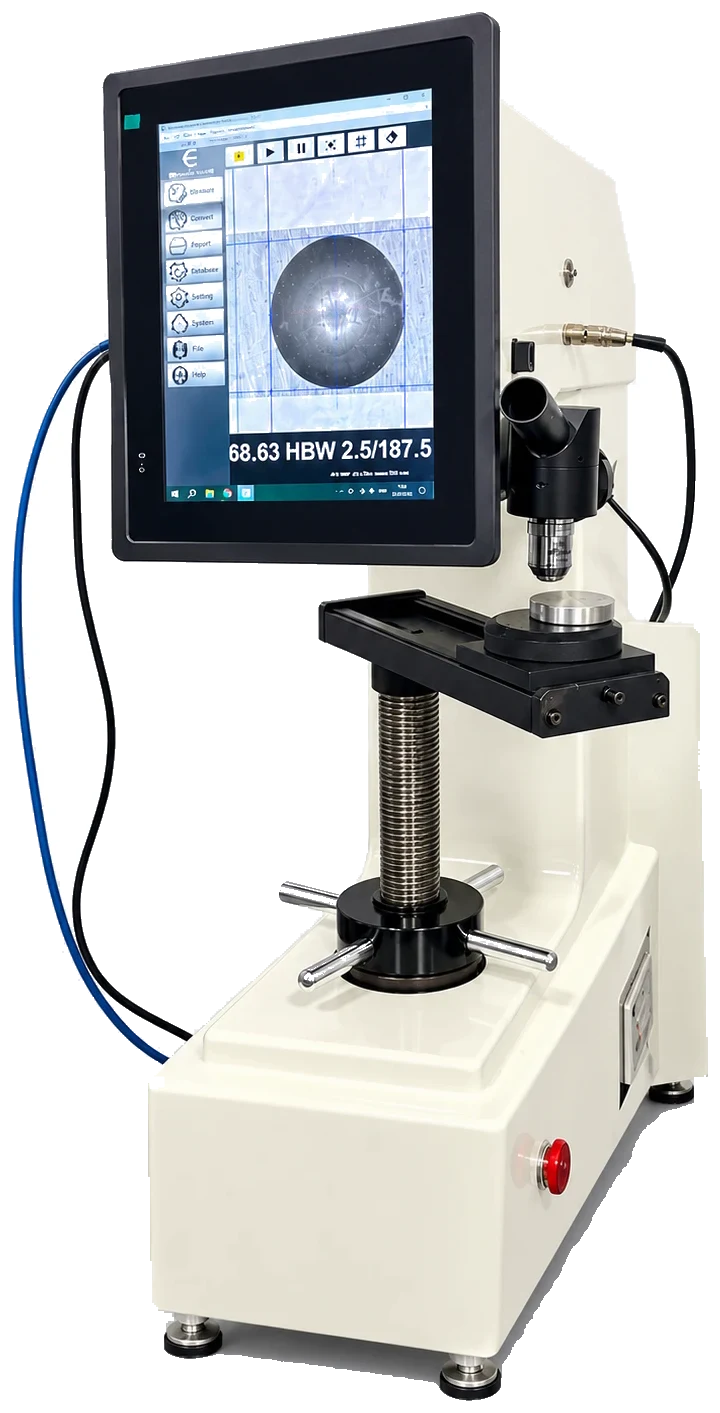
Electronic Brinell tester with a servo-driven ball-screw loading system under closed-loop load-cell feedback: the CPU monitors the applied force continuously and regulates the motor drive, so the test force is applied smoothly and repeatably without dead weights. After the indentation the turret indexes the built-in camera over the impression and the software on the integrated 10-inch industrial PC measures the diameter and calculates the BHN automatically.
The ETS-LB3000 is an electronic Brinell hardness tester from Eklavya Techno Solutions, Ichalkaranji, India, that replaces hydraulic or dead-weight loading with a servo motor, precision ball screw and closed-loop load-cell control. The CPU reads the load cell continuously and regulates the motor so the test force is applied smoothly and held within tolerance through the dwell, with any deviation corrected automatically. Test loads run from 62.5 kgf up to 3000 kgf, so the same machine covers HBW 2.5 and 5 mm ball scales on small or soft parts and the reference HBW 10/3000 scale on steel castings and forgings.
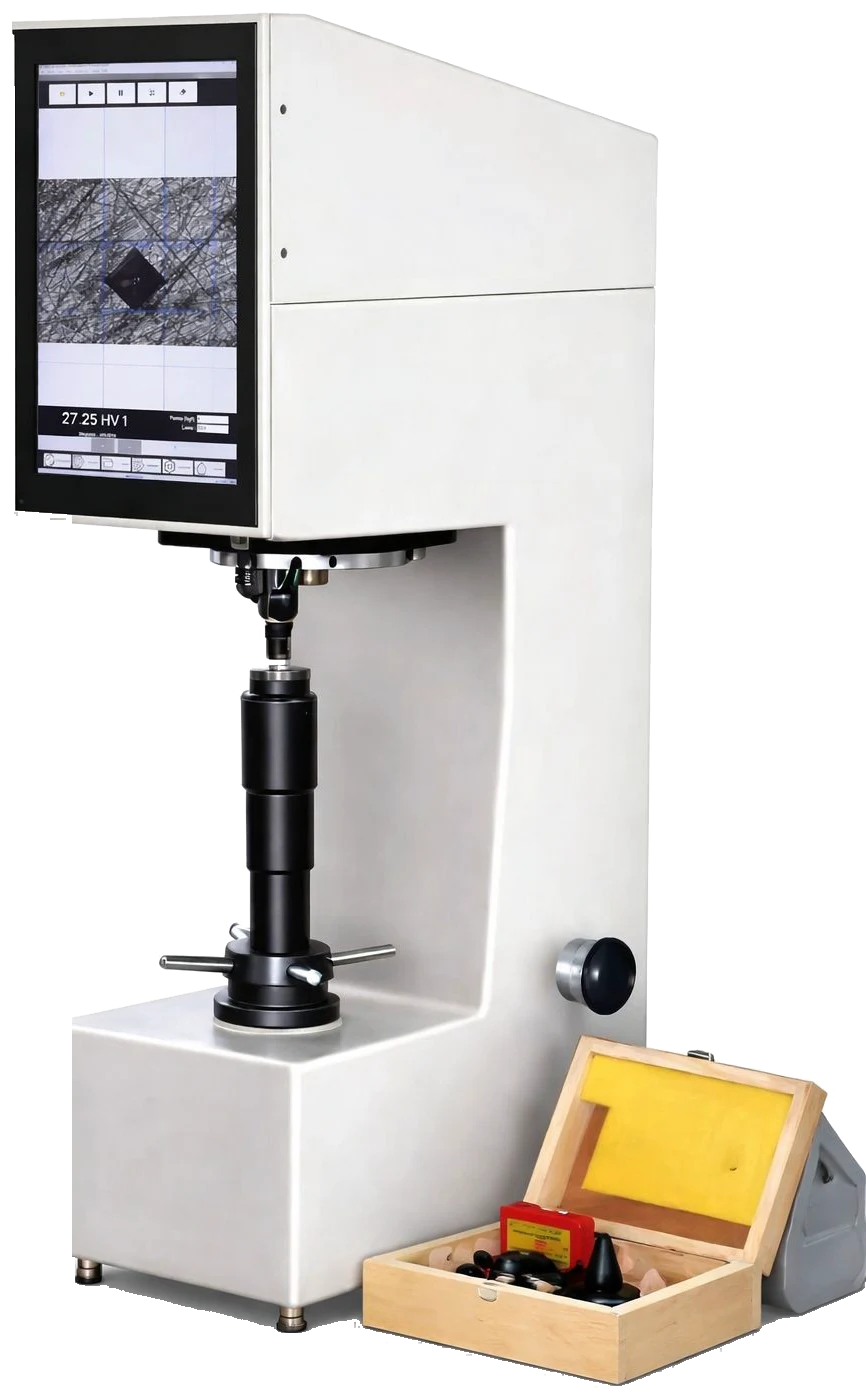
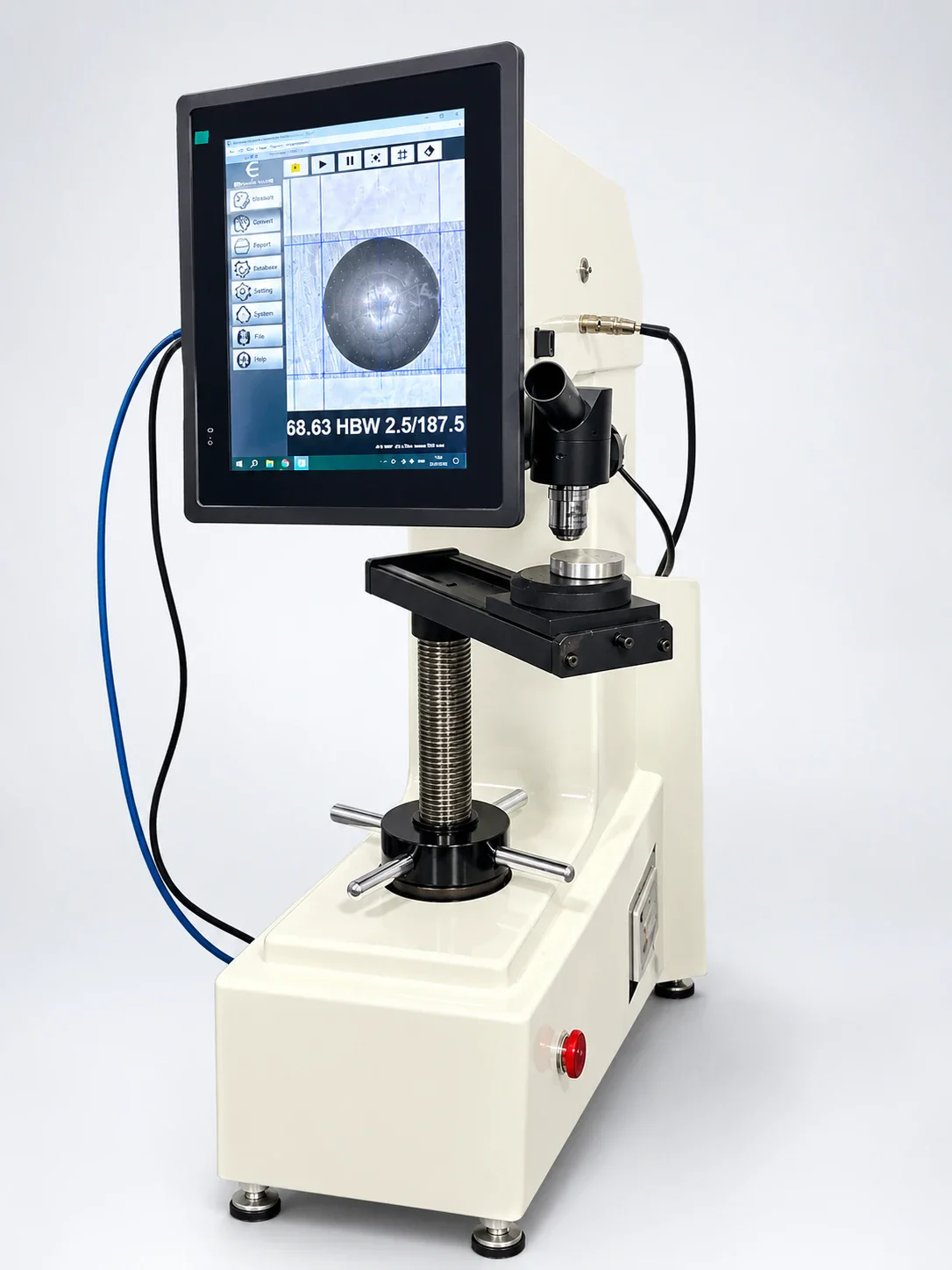
After the operator applies the preliminary force by hand the cycle is automatic: load, dwell and unload, then the turret indexes the built-in high-resolution CCD camera over the impression, and the ETS software on the integrated 10-inch industrial PC measures the diameter and calculates the Brinell hardness number without any manual measurement. Results can be exported over USB. The LB3000 has 380 mm test height and 200 mm throat depth, a 200 mm flat table and a 70 mm V-groove table for 10 to 80 mm rounds, an emergency stop, and complies with IS 1500 (Part 2), ASTM E10 and ISO 6506-2. Ball holders of 5 and 10 mm and HB 5/750 and HB 10/3000 test blocks are included.
Test loads: 62.5, 100, 125, 187.5, 250, 500, 750, 1000 kgf and up to 3000 kgf in stages of 250 kgf
IS 1500 (Part 2) – Brinell hardness test – verification and calibration of testing machines
ASTM E10 – Standard test method for Brinell hardness of metallic materials
ISO 6506-2 – Metallic materials – Brinell hardness test – verification and calibration of testing machines
| Parameter | ETS-LB3000 |
|---|---|
| Type | Brinell, servo ball-screw loading with closed-loop load cell, camera measurement |
| Test loads | 62.5, 100, 125, 187.5, 250, 500, 750, 1000 kgf and up to 3000 kgf in stages of 250 kgf |
| Loading cycle | Automatic load / dwell / unload after preliminary force applied by hand |
| Measurement | Automatic by turret-mounted CCD camera and software on the built-in 10" industrial PC |
| Magnification of objective | 25× |
| Measurement range | 1–6 mm |
| Scale least count | 0.01 mm |
| Max. test height | 380 mm |
| Depth of throat | 200 mm |
| Net weight (approx.) | 450 kg |
| Power supply | 415 V, 50 Hz, 3 phase |
| Standard tables | 200 mm dia flat table; 70 mm dia table with V-groove for 10–80 mm round jobs |
| Indenters supplied | 5 mm and 10 mm ball holders |
| Test blocks supplied | HB 5/750 and HB 10/3000 |
| Safety | Emergency stop |
A load cell measures the force actually applied to the indenter and the CPU adjusts the servo motor in real time to hold it at the set value, so the test force does not drift with oil temperature, valve wear or supply voltage. Force changes between the ten load steps are electronic, with no weights to change, and every test is applied at the same rate.
62.5, 100, 125, 187.5, 250, 500, 750 and 1000 kgf, then up to 3000 kgf in 250 kgf stages. With 5 mm and 10 mm ball holders supplied that gives HBW 5/750 and HBW 10/3000 for steel and cast iron, plus the lighter loads used on aluminium, copper alloys and small components; ask ETS about a 2.5 mm ball holder for the lowest loads.
Automatically. After unloading, the turret moves the indenter aside and aligns the integrated CCD camera, which views the impression through a 25x objective. The software on the built-in 10-inch industrial PC finds the edge, measures the diameter to 0.01 mm over a 1 to 6 mm range and displays the Brinell number, removing operator judgement from the reading.
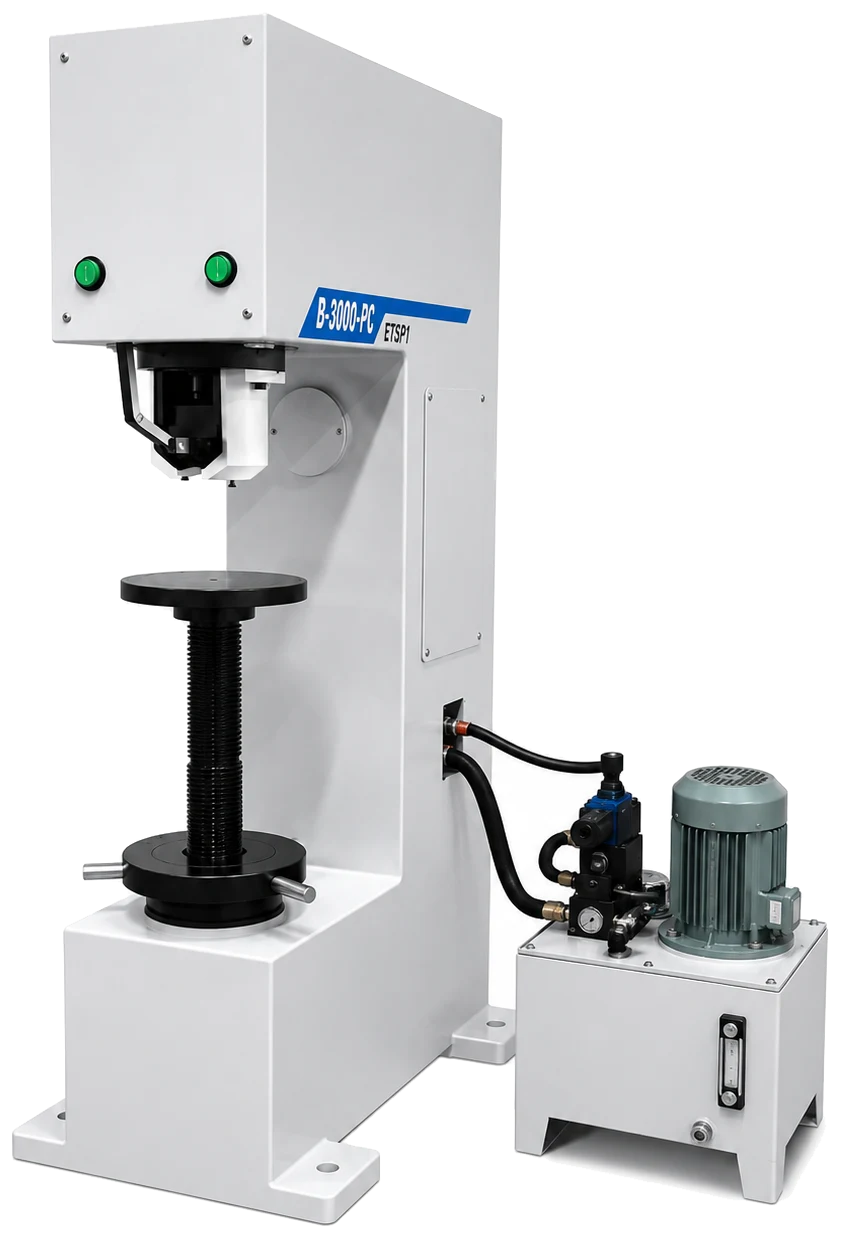
The B3000 machines apply the load hydraulically and start at 250 kgf; the LB3000 applies it by servo ball screw under load-cell feedback and starts at 62.5 kgf, so it reaches down to small and soft parts. Camera measurement is common to all, but the LB3000 has a turret and a built-in industrial PC, while the B3000 uses a customer PC or touch screen.
The ETS-LB3000 complies with IS 1500 (Part 2), ASTM E10 and ISO 6506-2. Certified HB 5/750 and HB 10/3000 test blocks are supplied so the force and measuring system can be verified at installation and checked routinely. ETS installs and commissions the machine on site anywhere in India and offers calibration with traceable certificates and AMC.
The machine runs on a 415 V, 50 Hz three-phase supply and weighs about 450 kg. It has an emergency-stop device and a robust mechanical structure for operator safety, a telescopic cover on the elevating screw, and a 200 mm flat table plus 70 mm V-groove table for 10 to 80 mm round jobs. Results export over USB for records.