Background information
Brinell hardness testing
IS 1500 (Part 2) · ASTM E10 · ISO 6506
The Brinell test presses a tungsten carbide ball of 1, 2.5, 5 or 10 mm diameter into the specimen under a test force between 62.5 and 3000 kgf, chosen so that the force-to-ball-diameter ratio suits the material (30 for steel, 10 for copper alloys, 5 or 2.5 for light alloys). After the dwell time the diameter of the impression is measured and the Brinell hardness number HBW is calculated from the force and the curved surface area of the impression.
The large impression averages out grain structure, porosity and local hard spots, which makes Brinell the preferred method for castings, forgings, rolled stock and other coarse-grained or heterogeneous materials that a Rockwell indent would sample too locally.
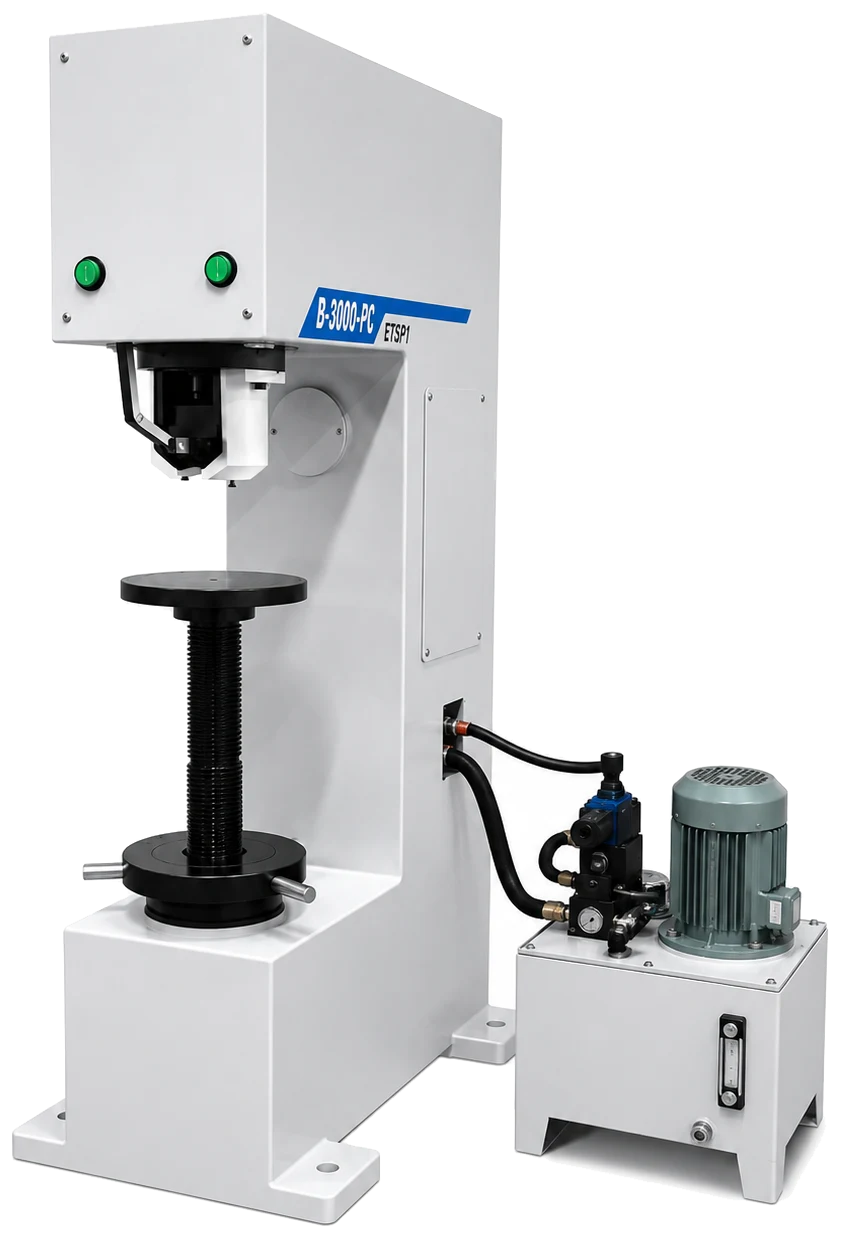
ETS Brinell testers use hydraulic or closed-loop load-cell loading with a CCD camera and ETS image-processing software to measure the impression and display the hardness value instantly, removing operator error from the microscope reading. Force and indenter verification follow IS 1500 (Part 2), ASTM E10 and ISO 6506-2.
 Made in India