 Made in India

ETS-LCB-3000AT
Load-cell Closed-loop Automatic Brinell Hardness Tester
ETS-LCB-3000AT
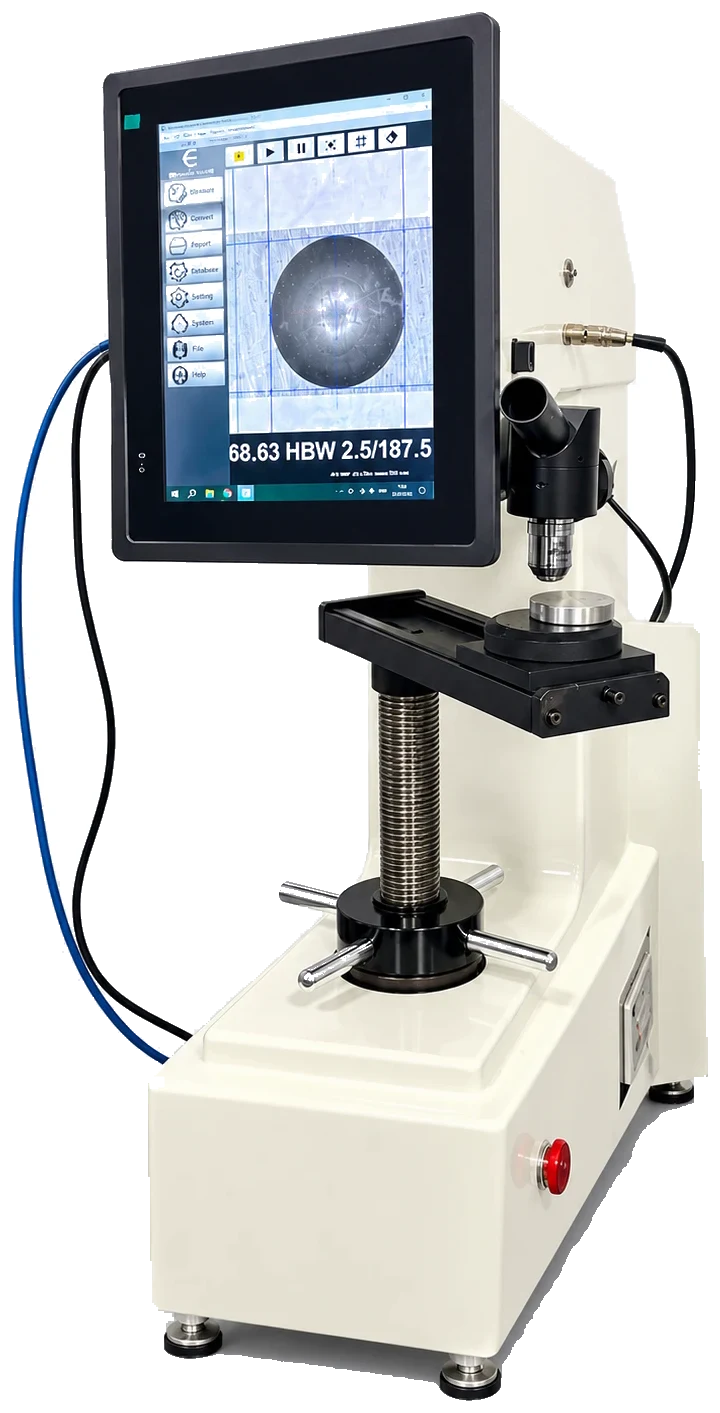
Fully motorised, closed-loop Brinell tester built around a high-accuracy load cell: force is generated electronically and held under real-time feedback through the load, dwell and unload cycle, eliminating weight changeover and giving repeatable force across the full 62.5 to 3000 kgf range. An automatic indenter turret and a digital eyepiece with built-in encoder let the operator measure the indentation and read the hardness directly on the touch screen.
The ETS-LCB-3000AT is a load-cell, closed-loop, fully motorised Brinell hardness tester offered by Eklavya Techno Solutions, Ichalkaranji, India. Force is generated electronically and controlled in real time by a high-accuracy load cell through the load, dwell and unload cycle, so there are no dead weights to change and the test force stays within ISO 6506 tolerance from 62.5 kgf to 3000 kgf in ten steps. That range gives twelve Brinell scales, from HBW 2.5/62.5 for soft alloys up to HBW 10/3000 for steel, and a hardness measuring range of 8 to 650 HBW.
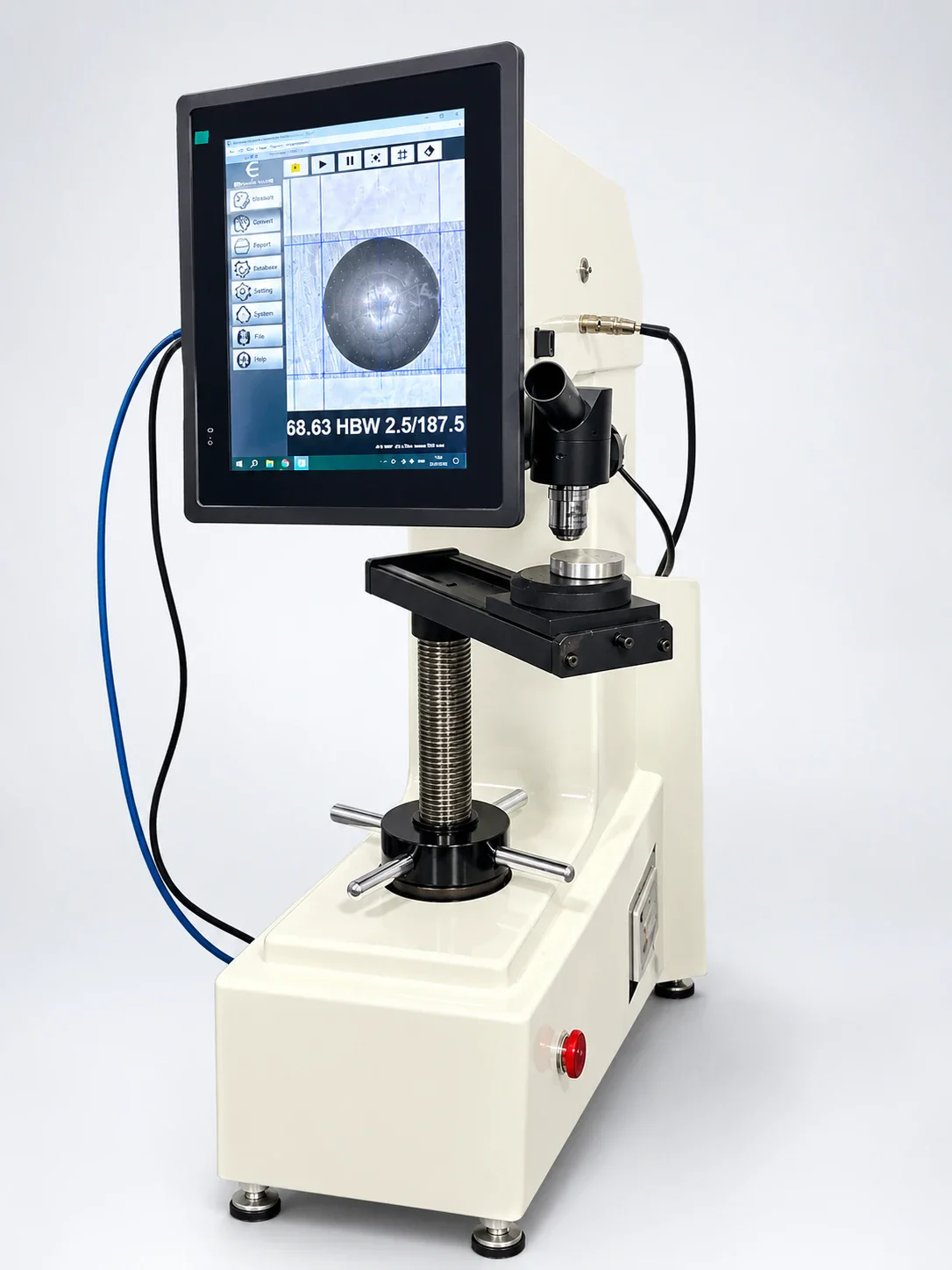
An automatic turret indexes the required tungsten-carbide ball indenter, 2.5, 5 or 10 mm, and after the test swings a digital eyepiece with built-in encoder over the impression; one click enters the diameter and the touch-screen LCD shows the hardness with built-in conversions. Dwell time is adjustable from 1 to 60 seconds. The one-piece cast body of about 130 kg gives stability in a compact 550 x 210 x 750 mm footprint, with a 200 x 135 mm test space. The LCB-3000AT complies with ISO 6506, ASTM E10, JIS Z2243 and GB/T 231.2 and is supplied with flat and V-type tables, high and low Brinell test blocks and the digital eyepiece.
Test force range: 62.5 to 3000 kgf (612.9 to 29420 N)
ISO 6506 – International standard for materials testing
ASTM E10 – Standard test method for Brinell hardness of metallic materials
JIS Z2243 – International standard for materials testing
GB/T 231.2 – International standard for materials testing
| Parameter | ETS-LCB-3000AT |
|---|---|
| Type | Brinell, load-cell closed-loop, automatic turret |
| Test force range | 62.5 to 3000 kgf (612.9 to 29420 N) |
| Test force steps | 62.5, 100, 125, 187.5, 250, 500, 750, 1000, 1500, 3000 kgf (10 steps, electronically controlled) |
| Available Brinell scales | HBW 2.5/62.5, 2.5/187.5, 5/62.5, 5/125, 5/250, 5/750, 10/100, 10/250, 10/500, 10/1000, 10/1500, 10/3000 |
| Hardness measuring range | 8 to 650 HBW |
| Microscope magnification | 20× |
| Minimum measuring unit | 0.125 µm |
| Dwell time | 1 to 60 s, adjustable |
| Display / data output | Touch-screen LCD with hardness conversion |
| Test space (height × depth) | 200 × 135 mm |
| Indenters | φ2.5, φ5 and φ10 mm tungsten-carbide ball indenters |
| Permissible error / repeatability (ISO 6506) | ±3.0 % / ≤3.0 % (≤125 HBW); ±2.5 % / ≤2.5 % (125–225 HBW); ±2.0 % / ≤2.0 % (>225 HBW) |
| Power supply | AC 220 V ±5 %, 50–60 Hz |
| Overall dimensions (L × W × H) | 550 × 210 × 750 mm |
| Net weight (approx.) | 130 kg |
| Standard accessories | Large flat, medium flat and V-type tables; high and low Brinell test blocks; digital eyepiece; spirit level; levelling foot screws; screwdriver and spanner set; dust cover; power cord; 2 A fuses |
Twelve scales from ten electronically controlled force steps: HBW 2.5/62.5, 2.5/187.5, 5/62.5, 5/125, 5/250, 5/750, 10/100, 10/250, 10/500, 10/1000, 10/1500 and 10/3000, covering 8 to 650 HBW. Tungsten-carbide ball indenters of 2.5, 5 and 10 mm are supplied and the automatic turret indexes the one the selected scale needs.
Cast iron, steel and steel products, non-ferrous metals, soft alloys and rigid plastics or Bakelite. The Brinell method averages hardness over a comparatively large area, which is why it correlates well with the tensile strength and machinability of castings, forgings and soft alloys where a Rockwell diamond would read an unrepresentative point.
With a digital eyepiece that has a built-in encoder: the turret swings it over the impression, the operator aligns the diameter and clicks once to enter it, and the hardness appears on the touch-screen LCD with conversions. There is no manual focusing or reading of a graduated scale; the minimum measuring unit is 0.125 micrometres at 20x magnification.
The LB3000 and B3000 are 450 kg machines with 380 mm test height and CCD camera measurement, hydraulic on the B3000 and servo load-cell on the LB3000. The LCB-3000AT is a compact 130 kg bench tester with a 200 x 135 mm test space, an automatic indenter turret and encoder eyepiece measurement, and adds the low-force 2.5 mm ball scales. It runs on single-phase 220 V.
The LCB-3000AT complies with ISO 6506, ASTM E10, JIS Z2243 and GB/T 231.2. Permissible error and repeatability follow ISO 6506: within 3 percent up to 125 HBW, 2.5 percent from 125 to 225 HBW and 2 percent above 225 HBW. High and low Brinell test blocks are supplied for verification at installation and routine checks.
Standard: large flat, medium flat and V-type tables, high and low Brinell test blocks, digital eyepiece, spirit level, levelling foot screws, screwdriver and spanner set, dust cover, power cord and 2 A fuses. Options: 1 mm and 1.5875 mm ball indenters, extra certified test blocks, external LED light source, PC connectivity with data-export software and a thermal printer.