 Made in India

VcB-250
Optical Vickers cum Brinell Hardness Testing Machine
VcB-250
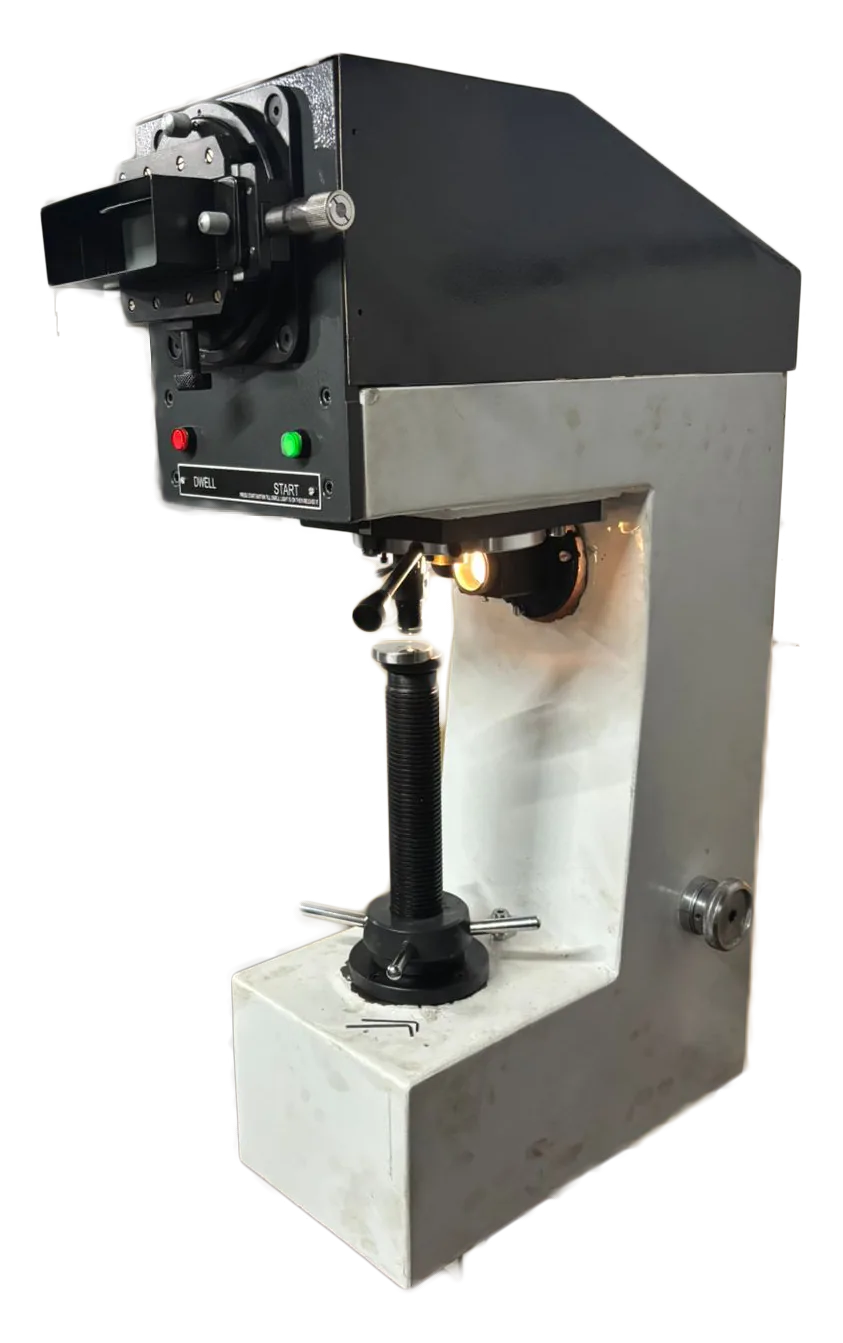
Compact and versatile dead-weight tester that performs both Vickers (5 to 120 kgf) and Brinell (15.625 to 250 kgf) tests on steels and other metals. Loads are selected with a push knob and applied by motorised loading; the indentation is projected on the built-in front focusing screen at 35× or 70× and measured with the graduated micrometer readout.
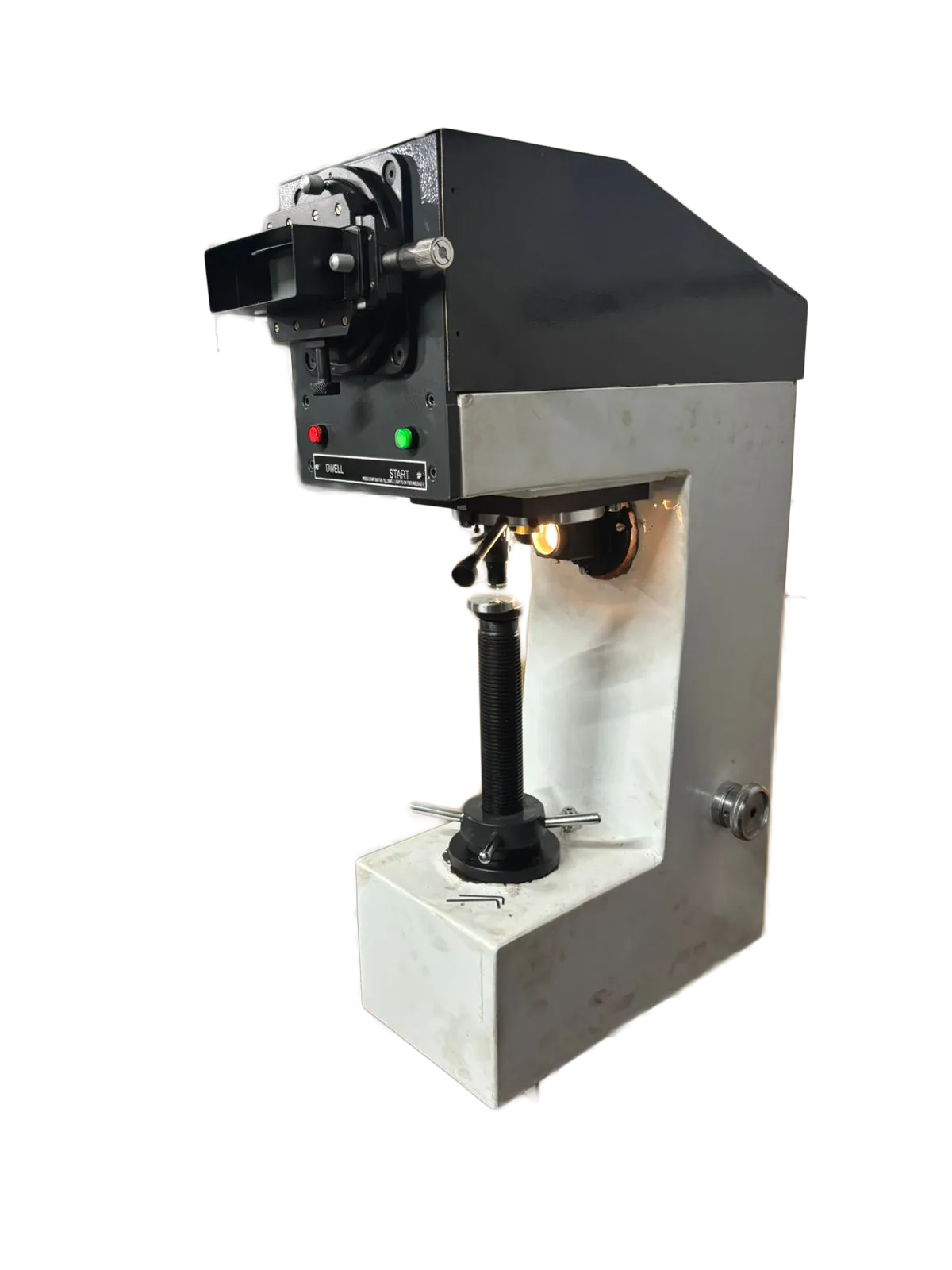
The VcB-250 is an optical Vickers cum Brinell hardness tester from Eklavya Techno Solutions, Ichalkaranji, India, that puts two hardness methods on one dead-weight machine. Vickers loads of 5 to 120 kgf drive a 136-degree diamond pyramid into the surface for hardened steel, tool steel, case depth and precision parts; Brinell loads of 15.625 to 250 kgf drive a 2.5 or 5 mm ball for castings, forgings, annealed steel and non-ferrous alloys. Loads are selected with a push knob, applied by motor from a front push button and released with a hand lever, with load accuracy within 1 percent.
After the indentation the objective swings into place automatically and the impression is projected onto the built-in front focusing screen at 35x or 70x, where the operator measures the Vickers diagonals or Brinell diameter with the graduated micrometer readout and reads the hardness from the tables. This is the classic laboratory approach: no camera, no computer, just a bright projected image and a precise micrometer. The VcB-250 offers 200 mm test height and 150 mm throat depth, weighs about 250 kg, runs on single-phase 220 V and complies with IS 1501 (Part 2), IS 1500 (Part 2), ASTM E92 and ASTM E10. A Vickers diamond, ball indenters and HV and HBW 2.5/187.5 test blocks are supplied.
Test loads for Vickers: 5, 10, 15, 20, 30, 40, 50, 60, 100, 120 kgf
IS 1500 (Part 2) – Brinell hardness test – verification and calibration of testing machines
ASTM E10 – Standard test method for Brinell hardness of metallic materials
IS 1501 (Part 2) – Vickers hardness test – verification and calibration of testing machines
ASTM E92 – Standard test methods for Vickers and Knoop hardness of metallic materials
| Parameter | VcB-250 |
|---|---|
| Type | Optical Vickers cum Brinell, dead-weight loads, motorised loading |
| Test loads for Vickers | 5, 10, 15, 20, 30, 40, 50, 60, 100, 120 kgf |
| Test loads for Brinell | 15.625, 31.25, 62.5, 187.5, 250 kgf |
| Load accuracy | Within ±1 % |
| Optical magnification | 35×, 70× (5× and 10× objectives) |
| Max. test height | 200 mm |
| Depth of throat | 150 mm |
| Machine dimensions (L × W × H) | 780 × 361 × 1100 mm |
| Net weight (approx.) | 250 kg |
| Power supply | 220 V AC, 50 Hz, 1 phase |
| Indenters supplied | Vickers diamond indenter; 2.5 mm and 5 mm ball indenters; spare 2.5 and 5.0 mm steel balls |
| Test blocks supplied | HV standard test block; Brinell 187.5/2.5 HBW test block |
| Other accessories | Halogen lamp, telescopic cover, spanners, electric cord, instruction manual |
Vickers loads of 5, 10, 15, 20, 30, 40, 50, 60, 100 and 120 kgf with the 136-degree diamond pyramid, and Brinell loads of 15.625, 31.25, 62.5, 187.5 and 250 kgf with 2.5 mm and 5 mm ball indenters. All are dead-weight loads selected with a push knob and applied by motor, accurate to within 1 percent.
Vickers uses one diamond indenter for every hardness from soft alloys to the hardest tool steels, and the small square impression makes it the method for thin sections, case-depth surveys, small precision parts and hardened surfaces. Brinell with its larger ball impression suits castings, forgings and coarse-grained or soft materials. The VcB-250 does both on one machine.
Optically. After the load is released the objective positions itself automatically and the impression is projected onto the front focusing screen at 35x or 70x magnification. The operator sets the graduated micrometer on the two diagonals of a Vickers impression, or the diameter of a Brinell one, and reads the hardness value from the standard tables.
The VM 50-TSPC is Vickers only, 5 to 50 kgf, and measures the impression automatically with a CCD camera and touch-screen PC software with batch reports and statistics. The VcB-250 adds Brinell up to 250 kgf and Vickers up to 120 kgf, but measurement is optical with a projection screen and micrometer, which some laboratories prefer for its simplicity.
The VcB-250 complies with IS 1501 (Part 2) and ASTM E92 for Vickers and IS 1500 (Part 2) and ASTM E10 for Brinell. It is supplied with a Vickers diamond indenter, 2.5 mm and 5 mm ball indenters with spare balls, an HV test block and an HBW 2.5/187.5 test block, halogen lamp, telescopic cover, spanners, cord and manual.