 Made in India

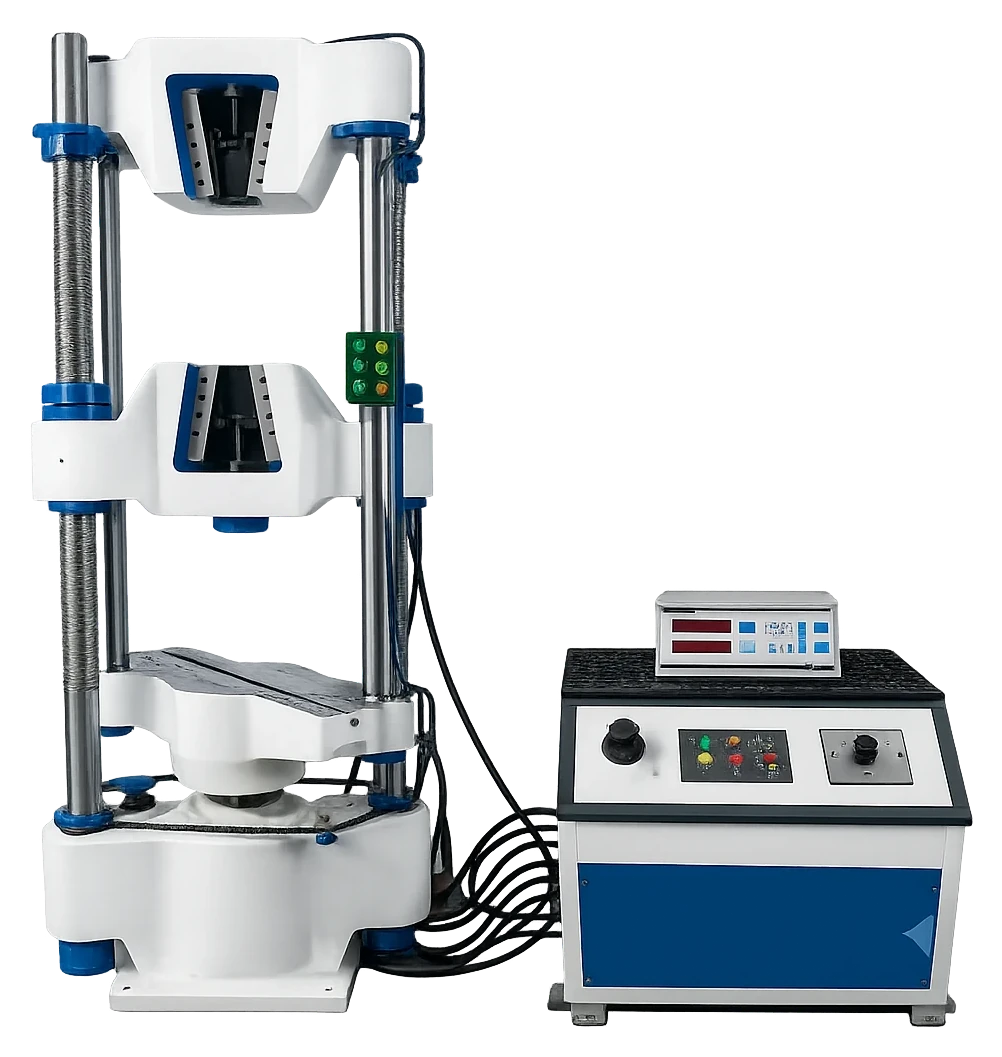
UTE 60
Electronic Universal Testing Machine, 600 kN
UTE 60
Hydraulic universal testing machine of 600 kN capacity with 600 mm column clearance and 800 mm tensile clearance for reinforcing bars, large fasteners and structural specimens. Digital load and displacement readouts, graphing and print-outs, USB and RS232C connection to PC software.
The UTE 60 is the 600 kN hydraulic universal testing machine from Eklavya Techno Solutions, Ichalkaranji, India, built for rebar mills, construction-material laboratories, forging plants and heavy fabricators that test larger bars, fasteners and structural specimens. Its frame is wider and taller than the smaller UTE machines, with 600 mm between columns, 800 mm tensile clearance and 250 mm ram stroke, so long rebar specimens, large bolts and bulky test pieces fit without difficulty. Load is applied by a hydrostatically lubricated main ram and measured by a fully enclosed pressure transducer with 50,000 counts, giving 12 N resolution and 1 percent accuracy from 12 to 600 kN.
The standard tooling covers 10 to 40 mm rounds and flats up to 30 mm thick and 70 mm wide, 120 mm compression plates, 50 mm transverse rollers with 600 mm support clearance and 16 and 22 mm radius punch tops for bend and rebend tests. A 2.5 HP pump provides an infinitely variable straining speed from 0 to 100 mm/min. The M-2301 microprocessor panel shows load and displacement live, prints results, graphs and batch certificates, and connects over USB and RS232C to optional Windows software for online curves and evaluation. The UTE 60 complies with IS 1828 (Part 1), ASTM E4 and ISO 7500-1.
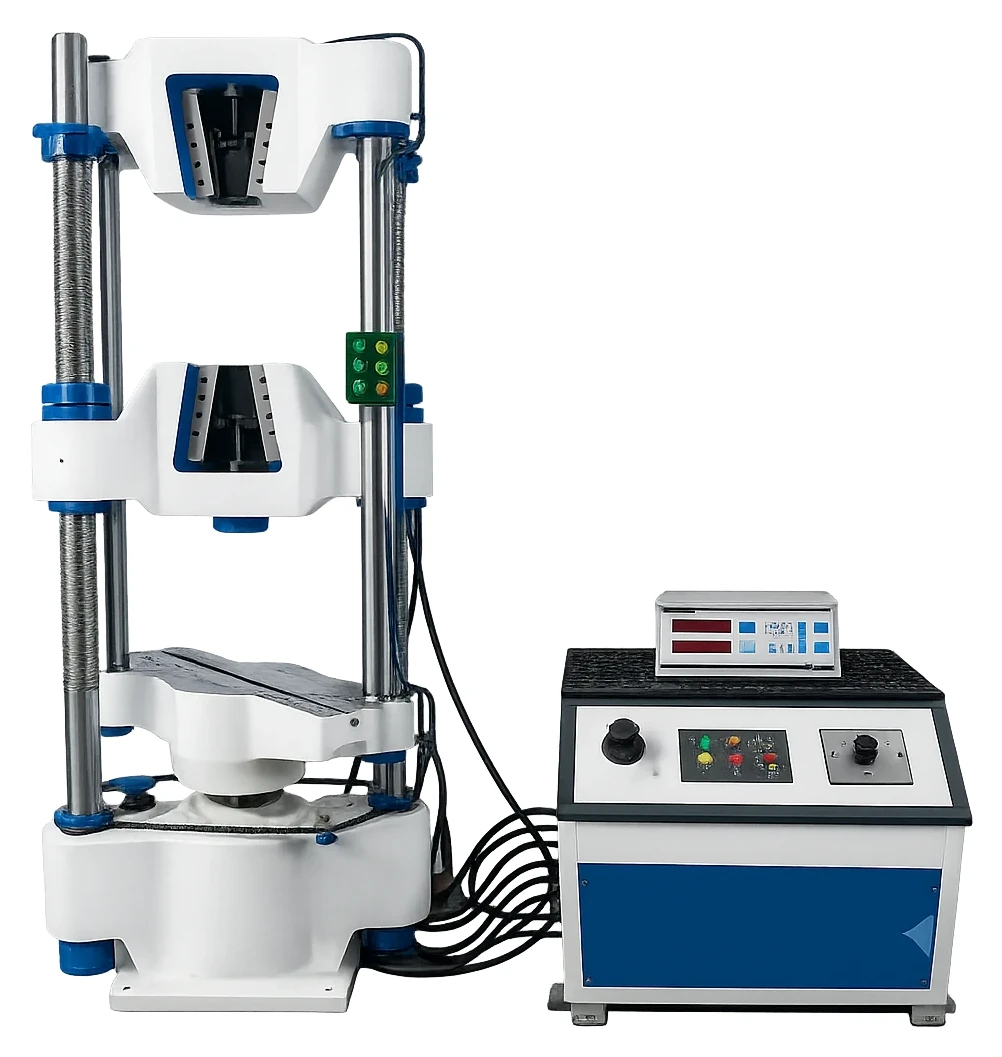
Maximum capacity: 600 kN
IS 1828 (Part 1) – Static uniaxial testing machines – verification and calibration of the force-measuring system
ASTM E4 – Standard practices for force verification of testing machines
ISO 7500-1 – Calibration and verification of static uniaxial testing machines – tension/compression testing machines
UTE series (hydraulic UTM): models compared side by side, current model highlighted.
| Parameter | UTE 10 | UTE 20 | UTE 40 | UTE 60 | UTE 100 |
|---|---|---|---|---|---|
| Type | Hydraulic, electronic universal testing machine | Hydraulic, electronic universal testing machine | Hydraulic, electronic universal testing machine | Hydraulic, electronic universal testing machine | Hydraulic, electronic universal testing machine |
| Maximum capacity | 100 kN | 200 kN | 400 kN | 600 kN | 1000 kN |
| Measuring range | 0–100 kN | 0–200 kN | 0–400 kN | 0–600 kN | 0–1000 kN |
| Load resolution (50,000 counts full scale) | 2 N | 4 N | 8 N | 12 N | 20 N |
| Load range with ±1 % accuracy | 2 to 100 kN | 4 to 200 kN | 8 to 400 kN | 12 to 600 kN | 20 to 1000 kN |
| Resolution of piston movement (displacement) | 0.1 mm | 0.1 mm | 0.1 mm | 0.1 mm | 0.1 mm |
| Clearance for tensile test (piston fully descended) | 50–700 mm | 50–700 mm | 50–700 mm | 50–800 mm | 50–850 mm |
| Clearance for compression test (piston fully descended) | 0–700 mm | 0–700 mm | 0–700 mm | 0–800 mm | 0–850 mm |
| Clearance between columns | 500 mm | 500 mm | 500 mm | 600 mm | 750 mm |
| Ram stroke | 150 mm | 200 mm | 200 mm | 250 mm | 250 mm |
| Straining / piston speed (no load) | 0–300 mm/min | 0–150 mm/min | 0–150 mm/min | 0–100 mm/min | 0–80 mm/min |
| Power | 1.33 HP, 400–440 V, 3 phase | 1.33 HP, 400–440 V, 3 phase | 2.33 HP, 400–440 V, 3 phase | 2.5 HP, 400–440 V, 3 phase | 4 HP, 400–440 V, 3 phase |
| Clamping jaws for round specimens (dia) | 10–20, 20–30 mm | 10–20, 20–30 mm | 10–25, 25–40 mm | 10–25, 25–40 mm | 10–25, 25–45 mm |
| Clamping jaws for flat specimens (thickness) | 0–10, 10–20 mm | 0–10, 10–20 mm | 0–15, 15–30 mm | 0–15, 15–30 mm | 0–22, 22–44 mm |
| Flat specimen width | 50 mm | 50 mm | 65 mm | 70 mm | 70 mm |
| Compression plates (dia) | 120 mm | 120 mm | 120 mm | 120 mm | 160 mm |
| Transverse test rollers (width / dia) | 160 mm / 30 mm | 160 mm / 30 mm | 160 mm / 30 mm | 160 mm / 50 mm | 160 mm / 50 mm |
| Max. clearance between supports | 500 mm | 500 mm | 500 mm | 600 mm | 800 mm |
| Radius of punch tops | 6, 12 mm | 6, 12 mm | 12, 16 mm | 16, 22 mm | 16, 22 mm |
| Note | Maximum allowable capacity for tensile test 80 % of machine capacity; full capacity for compression | Maximum allowable capacity for tensile test 80 % of machine capacity; full capacity for compression | Maximum allowable capacity for tensile test 80 % of machine capacity; full capacity for compression | Maximum allowable capacity for tensile test 80 % of machine capacity; full capacity for compression | Maximum allowable capacity for tensile test 80 % of machine capacity; full capacity for compression |
| Other capacities | 1200, 1500 and 2000 kN on request | 1200, 1500 and 2000 kN on request | 1200, 1500 and 2000 kN on request | 1200, 1500 and 2000 kN on request | 1200, 1500 and 2000 kN on request |
Tensile capacity is 80 percent of 600 kN, or 480 kN. That covers TMT rebar up to 25 mm with a comfortable margin and 32 mm at typical strengths, since a 32 mm bar at 600 MPa needs about 480 kN; for routine 32 mm and 40 mm testing choose the UTE 100. The jaws accept 10 to 40 mm rounds and the 16 and 22 mm punch tops serve bend and rebend tests.
Besides the higher capacity, the UTE 60 offers 600 mm between columns, 800 mm tensile clearance and 250 mm ram stroke against 500 mm, 700 mm and 200 mm on the UTE 40. That extra room matters for long rebar specimens with gauge marks, large bolts with fixtures and bulky castings or fabricated pieces tested in compression.
Tension, compression, bending, transverse and shear tests on ferrous and non-ferrous materials, and hardness tests with attachments. Compression uses the full 600 kN on 120 mm plates; transverse tests use 160 mm wide, 50 mm diameter rollers with up to 600 mm between supports. Fastener tensile testing is possible with suitable threaded adapters.
The M-2301 panel records peak load and prints results, load-displacement graphs, batch certificates and simple statistics directly. USB transfers data to a computer, and the RS232C port drives optional Windows software with online graph plotting, superimposed curves, point tracing and curve evaluation for yield, tensile strength, elongation and modulus.
The UTE 60 is verified to IS 1828 (Part 1), ASTM E4 and ISO 7500-1 for its force-measuring system and used for tests to IS 1608, IS 1786, ASTM E8 and ISO 6892. ETS installs and load-verifies the machine on site across India; the pump is 2.5 HP on a 400 to 440 V three-phase supply.