 Made in India

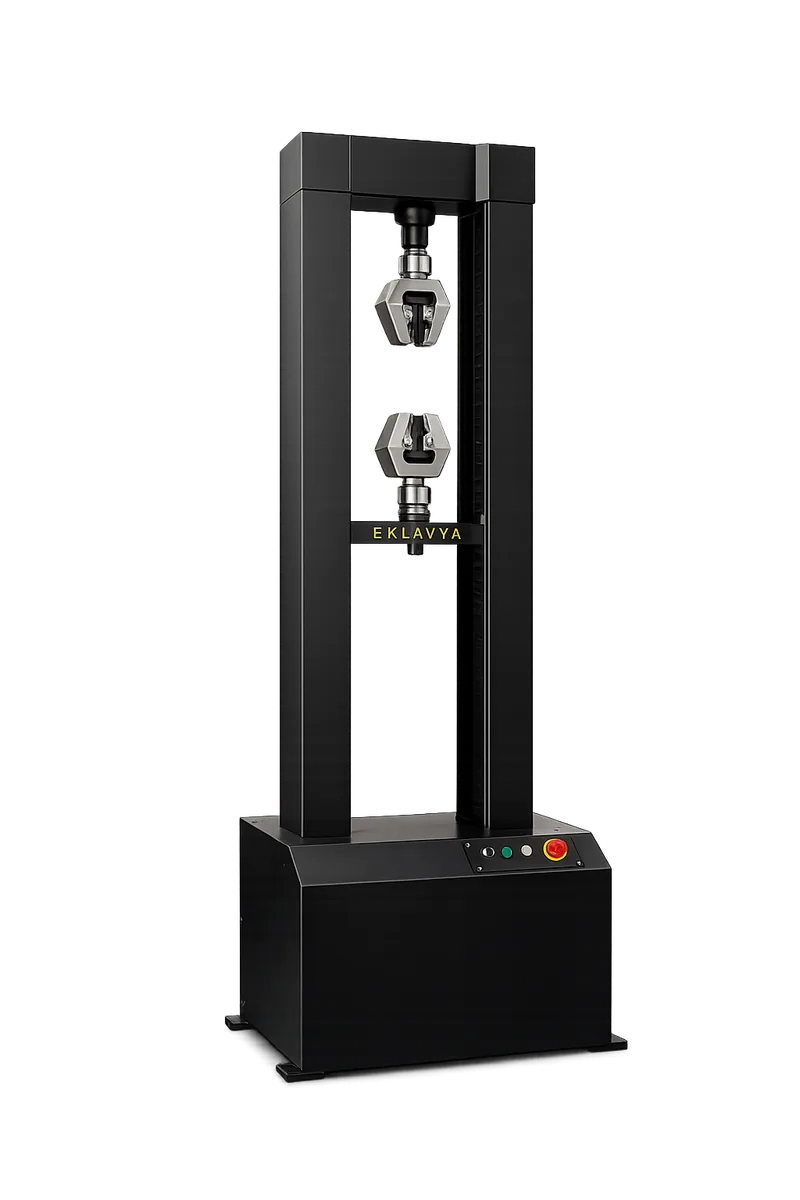
ETS-TNE-1T
Electro-mechanical Universal Testing Machine, 10 kN
ETS-TNE-1T
Microcontroller-based, servo-driven electro-mechanical universal testing machine of 10 kN (1 t) frame capacity for studying the mechanical behaviour of metals, polymers, composites, textiles, rubber and more. A high-precision ball-screw drive with AC servo motor gives smooth, backlash-free motion from 1 to 500 mm/min, and interchangeable, auto-detected load cells from 100 N to 10 kN cover thin wires, films, sheets and small components.
The ETS-TNE-1T is the 10 kN (1 t) frame of the electro-mechanical ETS-TNE universal testing machine series from Eklavya Techno Solutions, Ichalkaranji, India. An AC servo motor drives a precision ball screw for smooth, backlash-free crosshead motion at any speed from 1 to 500 mm/min, and interchangeable strain-gauge load cells from 100 N to 10 kN are detected automatically when fitted, so the same machine measures the breaking force of a fine wire or a plastic film as accurately as the tensile strength of a small metal specimen. Direct readout is in N or kN on the M-2301 microprocessor panel.
That combination suits polymer, textile, packaging, wire, rubber and electronics laboratories, research departments and colleges. Versatile fixture and load-cell mounting accepts thin wires, metal sheets, fibreglass, leather, springs and cardboard, with wedge, vice and threaded grips, compression plates, bending fixtures and shear attachments available, plus the optional EE2 strain-gauge extensometer with 1 micrometre resolution for modulus work. Overload protection and limit-switch interlocks protect the operator and the machine, and results print directly or pass over USB and RS232C to optional Windows software. The TNE-1T runs on single-phase 230 V and complies with IS 1828 (Part 1), ASTM E4, ISO 7500-1, ASTM E8 and ISO 6892.
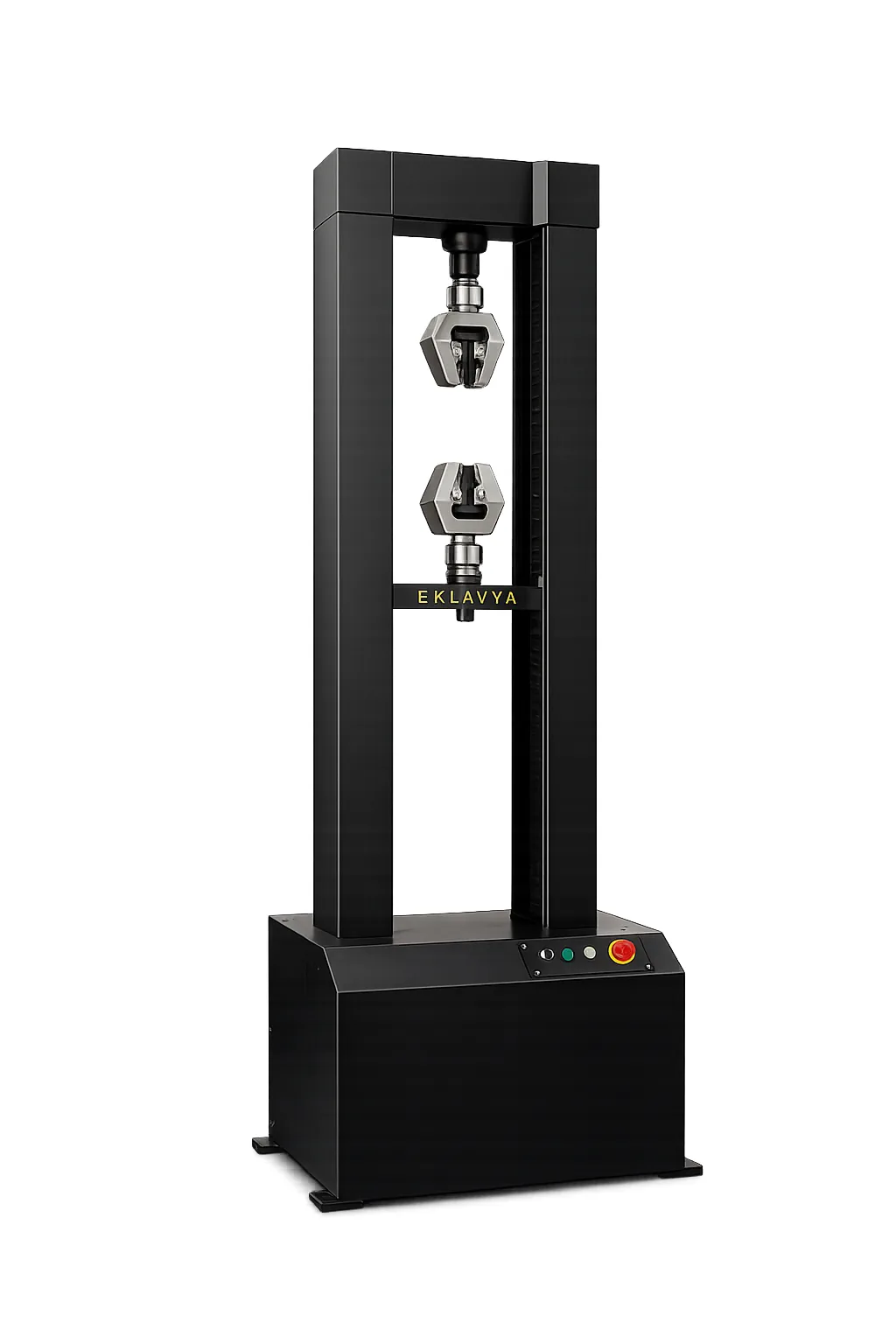
Max. capacity: 10 kN (1 t)
IS 1828 (Part 1) – Static uniaxial testing machines – verification and calibration of the force-measuring system
ASTM E4 – Standard practices for force verification of testing machines
ISO 7500-1 – Calibration and verification of static uniaxial testing machines – tension/compression testing machines
ASTM E8 – Standard test methods for tension testing of metallic materials
ISO 6892 – Metallic materials – tensile testing
ETS-TNE series (electro-mechanical UTM): models compared side by side, current model highlighted.
| Parameter | ETS-TNE-1T | ETS-TNE-2.5T | ETS-TNE-5T | ETS-TNE-10T |
|---|---|---|---|---|
| Type | Electro-mechanical universal testing machine, twin column | Electro-mechanical universal testing machine, twin column | Electro-mechanical universal testing machine, twin column | Electro-mechanical universal testing machine, twin column |
| Max. capacity | 10 kN (1 t) | 25 kN (2.5 t) | 50 kN (5 t) | 100 kN (10 t) |
| Drive | AC servo motor with high-precision ball screw | AC servo motor with high-precision ball screw | AC servo motor with high-precision ball screw | AC servo motor with high-precision ball screw |
| Load cells | Strain-gauge type, auto-detected: 100 N, 250 N, 500 N, 1 kN, 2.5 kN, 5 kN, 10 kN (others on request) | Strain-gauge type, auto-detected: 250 N, 500 N, 1 kN, 2.5 kN, 5 kN, 10 kN, 25 kN (others on request) | Strain-gauge type, auto-detected: 500 N, 1 kN, 2.5 kN, 5 kN, 10 kN, 25 kN, 50 kN (others on request) | Strain-gauge type, auto-detected: 1 kN, 2.5 kN, 5 kN, 10 kN, 25 kN, 50 kN, 100 kN (others on request) |
| Speed range | 1 to 500 mm/min | 1 to 500 mm/min | 1 to 500 mm/min | 1 to 500 mm/min |
| Speed setting | Digital data entry or potentiometer | Digital data entry or potentiometer | Digital data entry or potentiometer | Digital data entry or potentiometer |
| Load readout | kN or N, direct on panel | kN or N, direct on panel | kN or N, direct on panel | kN or N, direct on panel |
| Control panel | Series Universal M-2301 microprocessor panel, membrane keypad, 7-segment display | Series Universal M-2301 microprocessor panel, membrane keypad, 7-segment display | Series Universal M-2301 microprocessor panel, membrane keypad, 7-segment display | Series Universal M-2301 microprocessor panel, membrane keypad, 7-segment display |
| Interfaces | Parallel printer port; RS232C for Windows PC software; USB | Parallel printer port; RS232C for Windows PC software; USB | Parallel printer port; RS232C for Windows PC software; USB | Parallel printer port; RS232C for Windows PC software; USB |
| Extensometer | Optional electronic extensometer Model EE2, strain-gauge type, 1 µm resolution | Optional electronic extensometer Model EE2, strain-gauge type, 1 µm resolution | Optional electronic extensometer Model EE2, strain-gauge type, 1 µm resolution | Optional electronic extensometer Model EE2, strain-gauge type, 1 µm resolution |
| Grips and fixtures | Wedge, vice and threaded grips; compression plates; bending fixtures; shear attachments | Wedge, vice and threaded grips; compression plates; bending fixtures; shear attachments | Wedge, vice and threaded grips; compression plates; bending fixtures; shear attachments | Wedge, vice and threaded grips; compression plates; bending fixtures; shear attachments |
| Safety | Overload protection and upper/lower limit switches | Overload protection and upper/lower limit switches | Overload protection and upper/lower limit switches | Overload protection and upper/lower limit switches |
| Power supply | 230 V AC, 50 Hz, 1 phase | 230 V AC, 50 Hz, 1 phase | 230 V AC, 50 Hz, 1 phase | 230 V AC, 50 Hz, 1 phase |
A servo motor and ball screw give precise, repeatable speed control down to 1 mm/min with no hydraulic oil, pump noise or three-phase supply, and interchangeable load cells keep the accuracy high at low forces. For specimens from 100 N to 10 kN, such as wires, films, plastics, textiles and small metal parts, a hydraulic 100 kN machine cannot resolve the load adequately.
Auto-detected load cells of 100 N, 250 N, 500 N, 1 kN, 2.5 kN, 5 kN and 10 kN, others on request. That spans fine wire, plastic film and sheet, textiles, paper and cardboard, rubber, leather, fibreglass, springs, adhesives and small metal specimens, with the cell chosen so the expected force sits in the accurate part of its range.
By digital data entry on the M-2301 panel or with a potentiometer, anywhere from 1 to 500 mm/min. The AC servo motor holds the set crosshead speed under load through the ball screw, which is what test standards for plastics, textiles and rubber require. The panel records load and extension throughout the test.
Yes, with the optional EE2 electronic extensometer, a strain-gauge type with 1 micrometre resolution that clips onto the specimen. The panel or the Windows software then computes modulus along with peak load, rupture percentage and elongation, and the software plots and superimposes curves for comparison. Crosshead displacement is recorded in every case.
The load-measuring system is verified to IS 1828 (Part 1), ASTM E4 and ISO 7500-1, and the machine is used for tensile tests to ASTM E8 and ISO 6892 and the ASTM, ISO and IS methods for plastics, textiles and rubber. ETS installs and verifies the machine on site across India. Confirm the frame capacity and load-cell range for your application with ETS when ordering.
The TNE-500 machines are 500 kg (about 5 kN) platforms with their own panel: the SERVO edition has a colour touch screen with a live graph and 1 to 1000 mm/min, the AC edition a keypad and LED display. The TNE-1T is the 10 kN frame of the main TNE series with the M-2301 panel and load cells from 100 N to 10 kN.